

How refining margins impact the cost of diesel and petrol
What is the crack spread?
Crude oil is not a usable fuel. It must be processed into diesel, petrol, jet fuel and other petroleum-based products. Refineries, which are responsible for this process, charge a fee. Markets refer to this fee as the ‘crack spread’, because refining “cracks” crude into lighter fractions.
The marginal cost of refining is a function of the supply of crude, available refining capacity, and the demand for petroleum products. It rises when demand for a particular product exceeds the ability of the world’s refineries to produce it and falls when supply of that product is in excess.
Refineries are predominantly located near ports and are generally far from oil wells, requiring crude to be transported via tankers or pipelines. Refined product must then be shipped to its destination (Figure 1). The elementary price of fuel (petrol, diesel, jet fuel etc) is the sum of the price of crude, cost of refining and freight costs.
Figure 1: Petroleum supply chain

Source: Matrix
Since the Russia-Ukraine war, refining costs have risen 960% while crude oil is up 80%
Middle Eastern and Russian refiners have come under fire in both conflicts, because these countries rely on exports of refined products to fund their fiscus. Ukrainian long-range drone strikes have also targeted Russian refineries to cut off fuel supplies for military vehicles, tanks, and logistics.
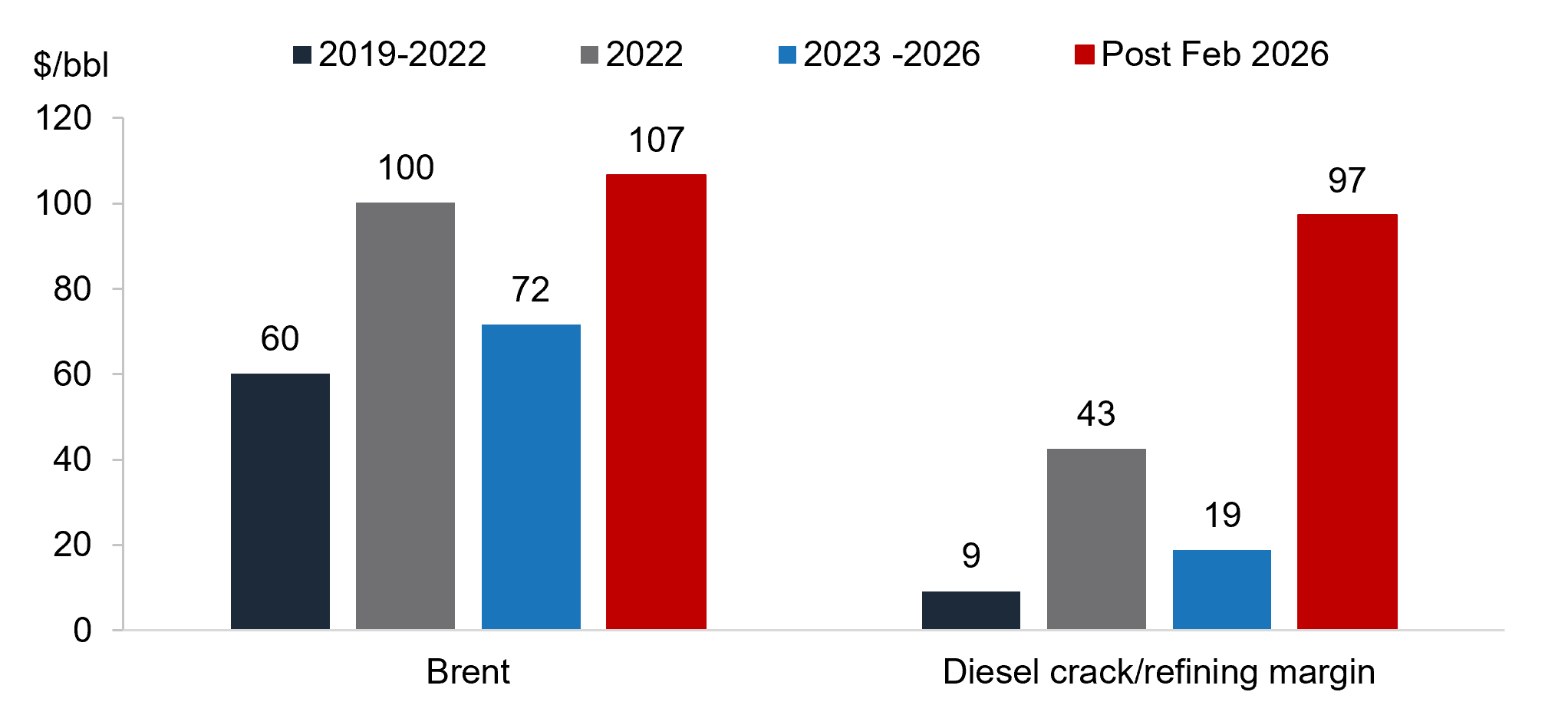
Historically, the crack spread has been small and stable relative to the price of crude and has garnered little attention (Figure 2). Its contribution to inflation has been at or close to zero. But after Russia’s invasion of Ukraine in 2022, geo-political dynamics governing the cost of refining changed, and supply chains experienced bottlenecks and disruptions. Diesel crack spreads spiked to $60/bbl in 2022/23, up from a long-term average of $9/bbl, and settled at a new, post-war equilibrium of around $20/bbl (Figure 3). Crude reached a high of $130/bbl in 2022, falling back to $70/bbl.
The war with Iran, which started at the end of February 2026, combined with the ongoing Russia-Ukraine war, has caused refined product prices to escalate well above the 2022/23 highs. The price of Brent crude is trading around $100/bbl, up 80% from before the Russia-Ukraine war and in line with 2022/23 levels. But the crack spread for diesel has risen to over $95/bbl, up a staggering 960% over the same period. Freight rates and insurance costs have also risen, adding to fuel prices paid at the pump.
Figure 2: Since 2022, refining spreads have blown out, while crude remained relatively stable

Source: Bloomberg, Matrix
Figure 3: Average price of Brent and refining spreads pre and post Russia-Ukraine and Iran wars ($/bbl)
Source: Bloomberg, Matrix
SA inflation is being driven by global refining capacity
Since the outbreak of the Iran war, South Africa’s inflation rate has been driven primarily by fuel. Fuel, in turn, has been driven more by global refining costs than crude itself. Whereas refining accounted for 25% of the basic diesel price in February 2026 (R2.40/litre), as of September 2026 it comprised 44% (R8.50/l).
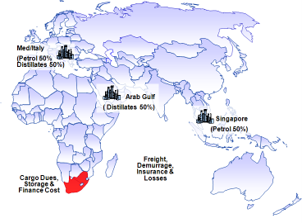
Following the closure of South African refineries SAPREF, Enref and PetroSA (Figure 4), and the sale of oil reserves, South Africa imports 94% of its diesel and 77% of its petrol, according to the SA Fuels Industry Association, and has little control over the cost of refining. South Africa currently imports diesel (distillates) from the Arabian Gulf and the Mediterranean and petrol from Singapore as well as the Mediterranean (Figure 5).
Figure 4: SA’s lost refining capacity Figure 5: SA’s diesel and petrol imports

Source: The Outlier, Dep of Minerals and Energy Source: Fuels Industry Association of SA
Diesel prices have risen by more than petrol
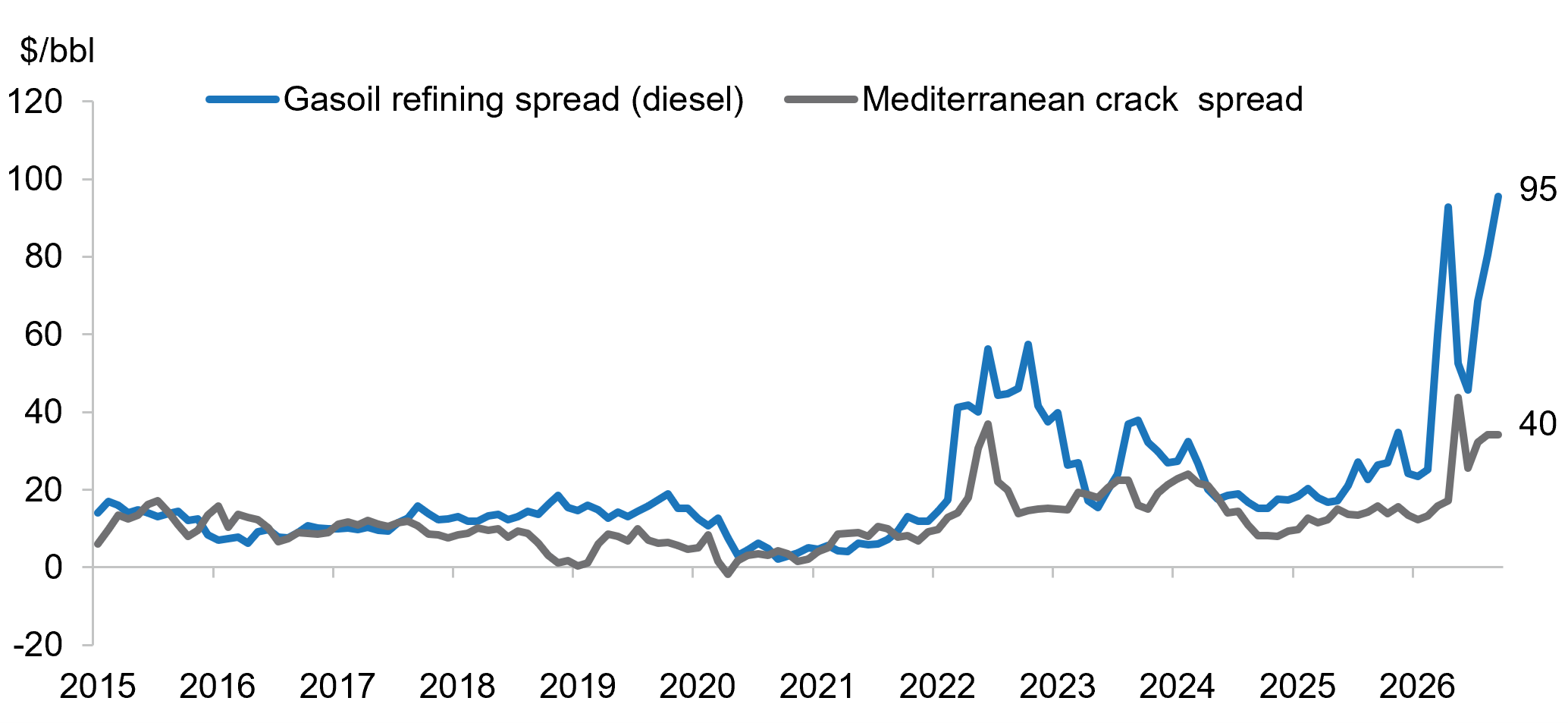
Since February, diesel crack spreads have risen 460%, to $95/bbl while petrol crack spreads have increased 180%, to $40/bbl.
Figure 6: Diesel versus petrol crack spreads
Source: Bloomberg, Matrix
From a crude oil perspective, the Middle East produces heavier crudes, which yield a higher proportion of diesel and jet fuel than petrol. From a refining perspective, offline capacity (Russia and Middle East) has disproportionately been configured for diesel. Middle Eastern refineries are specialised to produce more diesel and jet fuel than petrol and Ukrainian and Iranian drone attacks on refinery infrastructure in Russia and the Middle East have destroyed significant diesel-producing capacity. In August, Ukraine carried out more than 20 attacks on Russian refineries, and several more have suffered attacks in September. Due to domestic shortages, Russia recently extended its export ban on diesel until the end of October 2026 according to Reuters, and on petrol until the end of the year.
Unfortunately for consumers, petrol crack spreads are now also rising, and indications are that they will continue to catch up with diesel over the coming months.
SA has become more dependent on diesel
Compounding South Africa’s exposure to the phenomenal blow out in crack spreads is that the country has become increasingly dieselised. This is mainly due to increased freight trucking in response to Transnet’s collapse and more reliance on backup power generators by households, industry and Eskom’s own Open-Cycle Gas Turbines. In the absence of freight rail capacity, which has fallen to 14.5Mt per annum from a peak of 20Mt in 2015, road freight volumes have grown from 60Mt to 80Mt over the same period (data Stats SA and The Outlier). South Africa’s diesel usage outpaces its petrol use and plays a larger role in transmitting a supply side fuel shock to core inflation, via freight, food and standby generation.
The cost of refining is expected to remain elevated
Crude is a deep, liquid, heavily traded market. Conversely, the market for refined products is physical, less liquid and largely OTC (Over the Counter), which refers to buyers and sellers having to negotiate directly or through brokers rather than via a centralized exchange. Price discovery for refined products is heavily reliant on real-time data providers and private reporting agencies (such as Argus or Platts) which track OTC transactions. Prices are stickier than for crude because increased supply requires building new refineries, while increasing the supply of crude could be achieved by changing OPEC’s production quotas.
It is important to note that in 2022/23, at the start of Russia’s attack of Ukraine, Ukraine was not targeting Russian refining assets as it is now. Rather, the increase in refining costs was driven by disruptions to trade flows of crude oil and refined products, as opposed to destruction of capacity. Refining margins remained elevated for 15 months despite the absence of direct missile strikes on Russian refining assets, and a war in Iran. Under current circumstances, which are far more damaging to the distillate supply chain, it is reasonable to expect that refining margins could take more than 15 months to normalise, even if the Strait of Hormuz does fully open.
Implications for SA inflation and rates
Refining margins should remain structurally higher for longer, supported by tighter inventories, reduced refinery capacity and utilisation, and ongoing disruptions to global crude and product trade flows. Accounting for petrol and diesel prices remaining higher for longer we expect CPI inflation will average 5.5% until mid-2027.
Under the new 3% inflation targeting regime, it will be harder for the SARB to look through such a prolonged fuel-driven supply side shock to inflation, especially as it starts to feed through to freight, food and services, as is already becoming evident. Depending on the extent of the pass-through, the SARB could hike by a further 25bp to 7.50% in November.
It is in the early years of a new inflation targeting regime when anchoring is most vulnerable, and credibility is most expensive to lose. Monetary policy should remain tighter than under a 4.5% target and consequently we expect the policy rate to stay higher for longer, with the SARB taking a cautious, wait and see approach with respect to cutting into fuel-driven disinflation in 2027.
– End –
