

Capital inflows have been battered by headwinds, which may be abating
Over the past decade, South Africa has experienced step changes in its capital flow dynamics. In 2015, post Nenegate, investors lost confidence in the country’s fiscal sustainability and started to position for a sovereign downgrade. This materialised in 2020, triggering expulsion from the FTSE World Government Bond Index (FTSE WGBI) and the loss of index tracking capital inflows. A further shift came in 2022, National Treasury (NT) increased SA’s offshore investment limit from 30% to 45%, initiating another wave of capital outflows, this time by domestic investors. As a result, the stock of foreign investment in South Africa is less than South African investment abroad.
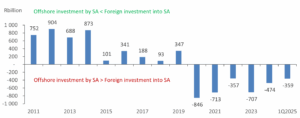
Until 2015, the value of non-resident investment in SA was greater than South African investment offshore. In 2015, this positive balance narrowed to R100bn and in 2020 it turned sharply negative as SA’s offshore investments outstripped non-resident investments into the country. This reversal has negatively affected demand for domestic assets, especially the currency. However, there is a case to be made that although not yet complete, the bulk of the headwinds from these structural reallocations may be behind us.
Figure 1: Stock of net foreign investment in South Africa (liabilities minus assets)
Source: SARB, Matrix FM
SA equities have done most of the adjustment
According to data published by the South African Reserve Bank (SARB), foreigners sold R340bn of JSE-listed shares from 2015 to 2020, a further R125bn in 2020. Since 2022 cumulative sales have exceeded R500bn, R140bn of which has been in 2025. Consequently, foreign ownership of JSE-listed equities has declined from 29% in 2015 to 18.3% in 2024.
Adding to equities’ woes. Following the increase in the offshore investment cap, South African asset managers and insurers expanded their net offshore allocations by R200bn in 2022, R32bn in 2023, and R51bn in 2024
Figure 2: Non-resident net purchases of equity and bonds

Source: SARB, Matrix FM
Signs of stabilisation in capital flows
While offshore allocations continue to grow, the pace of adjustment has slowed. South Africa’s total stock of foreign assets (excluding derivatives and SARB reserves) has plateaued. And encouragingly, foreign demand for bonds has started to recover even as equity flows have deteriorated. Foreign demand for bonds is more sensitive to global factors, unlike SA equities, which are predominantly influenced by domestic economics, and valuations relative to developed markets. Foreigners own around a quarter of South Africa’s government debt, down from 40% in 2018, but since 2023 have purchased R185bn of government bonds, albeit at higher interest rates.
Macro stability targets
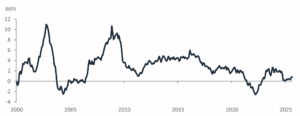
Low inflation, the pursuit of a lower inflation target and confidence in the reserve bank’s independence have increased the attractiveness of SA bonds and reduced currency risk. A sustained, narrower inflation differential between South Africa and the rest of the world should benefit the rand, and reduce its volatility, reducing the appeal of offshore allocations to hedge SA currency risk. Lower and more stable inflation should also lower the currency risk faced by offshore investors, and reduce the need to purchase costly currency hedging derivatives.
Figure: US/SA inflation differential
Source: Bloomberg, Matrix FM
From a fiscal perspective, a lower and more credible inflation target signals reduced risk of “inflating away” debt. In the absence of structural changes to real GDP growth, structural changes to inflation – such as lowering the target – may be the only meaningful way to assist with reducing bond yields, by reducing the inflation expectations component of the term premium. Lower yields will reduce the cost of refinancing debt that is due for redemption, increasing fiscal sustainability.
Institutional credibility would be further enhanced by the adoption of a fiscal anchor, which is currently under discussion between NT and its stakeholders. Investors and rating agencies have responded positively to suggestions that a fiscal anchor is adopted to set limits on debt levels, spending, and deficits (i.e., when spending exceeds revenue), as a way to keep these metrics from spiraling out of control. Such a framework, if credible, could play the same role for fiscal policy as inflation targeting has for monetary policy.
Tourism: an underappreciated source of inflows
Tourism inflows collapsed during the pandemic, falling from R120bn in December 2019 to just R10bn in June 2020. The cumulative loss of inbound travel receipts since 2020 exceeds R1 trillion. Only by 1Q25 did inflows finally return to pre-pandemic levels. With recovery under way, tourism could transform from a headwind into a significant source of foreign exchange support.
SA assets less exposed to offshore risk swings
Asset prices and capital flows have done much to adjust to the loss of the sovereign investment grade status, weak growth and higher offshore allocations. Growth expectations have been beaten into submission and asset prices are more reflective of reality and less prone to disappointment.
The rand, after weakening from R15.20/$ at the start of 2022 to R18.90/$ by end-2024, may also have priced in much of the bad news. And higher offshore allocations also provide a stabalising effect when dividends and interest are repatriated.
Going forward, reduced offshore ownership should make SA markets less vulnerable and more resilient in the face of offshore swings in risk appetite. At the very least, at the margin, capital flow dynamics may shift from being a headwind to a more neutral, or even supportive factor for investor returns.
